
Ethiopia’s Fault Lines and the Rising Call for Tigray’s Independence
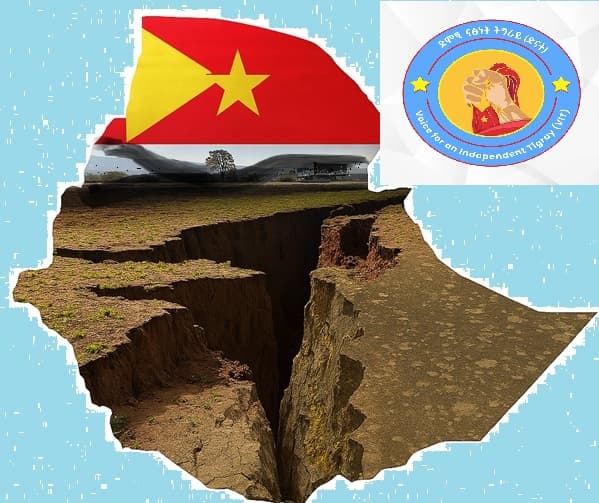
Ethiopia today stands fractured along deep fault lines—ethnic tensions, political exclusion, and prolonged conflict have torn the nation’s social fabric, forcing various Ethnic groups to contemplate breaking. Nowhere is this more evident than in Tigray, where decades of marginalization and recent brutal warfare have ignited an unstoppable demand for independence. As Ethiopia's fragile foundation crumbles, the rising call for Tigray’s sovereignty is not just a reaction to an emotional crisis but a powerful assertion of a people’s right to survival in the face of a systematic annihilation project.
Ethiopia’s leaders repeatedly opted for war as a means to suppress legitimate political questions for self-rule rights, equality, justice, and representation. There are clear and visible signs of danger that have been obvious to all. These warnings have been ignored, pushing Ethiopia to a tragic and irreversible crossroads. Sadly, Abiy Ahmed’s government displays not a flicker of remorse for the atrocities he has orchestrated. On the contrary, he persists—coldly and methodically—in his calculated campaign to annihilate the people of Tigray, now through quieter, more insidious means: starvation, political suffocation, and engineered decay.
In this critical moment, Tigray cannot afford to fail in asserting its right to choose and determine its own future. The stakes are nothing less than survival, dignity, and the preservation of a people long marginalized and subjected to systemic oppression. For Tigray, failure is not simply a political setback—it risks the erasure of its identity, freedoms, and the fundamental human rights that have been denied for far too long. As Winston Churchill once said, “To each, there comes in their lifetime a special moment when they are figuratively tapped on the shoulder and offered the chance to do a very special thing, unique to their talents and their purpose.” For Tigray, that moment is now. After enduring war, injustice, and betrayal, Tigray must make a call not merely to survive, but to rise—to seize this historic opportunity to shape its destiny while it still commands a formidable and battle-hardened force, forged through sacrifice and unmatched resilience. Make no mistake, this strength is not guaranteed forever. It must be harnessed now—before this undefeated force is disarmed, before internal divisions deepen, and before enemies who once inflicted unimaginable harm regain their footing. This is not just a political choice; it is a moral imperative to honor the lives lost, protect the living, and fulfill the undeniable right of the Tigrayan people to freedom and self-determination.
In the aftermath of the Tigray genocidal war and the hollow Cessation of Hostilities Agreement (CoHA), Ethiopia was presented with a historic opportunity to pursue peace, justice, and reconciliation. Instead, it failed to seize this moment and has expanded the conflict into other regions, including Oromia and Amhara, unleashing a brutal humanitarian crisis. Now, it is an open secret that Ethiopia is preparing for another war, not peace. The Abiy Ahmed regime has chosen a path of deception, militarization, and provocation—pushing Tigray and the entire Horn of Africa to the brink of yet another devastating war. Instead of honoring the CoHA by withdrawing invading forces from Tigray’s territories, restoring its pre-war territorial integrity, ensuring the safe and secure return of IDPs, and delivering justice and accountability through an independent investigation, the regime doubles down on aggression against Tigray and Eritrea. For the people of Tigray, this moment confirms beyond any doubt that their survival, dignity, and future cannot be secured within the existing framework of the Ethiopian state. Therefore:
1. The call for an independent Tigray is no longer a matter of political choice—it has become a historical imperative born of blood, betrayal, and survival.
2. Tigray’s demand for independence is not a fleeting ambition; it is a historic mandate forged in the fire of genocide and sustained by an unbreakable will to live free.
3. Independence for Tigray is no longer a distant hope—it is a moral and historical necessity carved out by suffering, resistance, and the failure of the Ethiopian state.
4. The push for Tigrayan independence has transcended politics; it is now an existential imperative demanded by history, justice, and the undeniable right to self-determination.
5. This is not a political movement—it is a historic reckoning. Tigray's pursuit of independence has become a non-negotiable demand for dignity, safety, and rightful nationhood.
A Diplomatic Smokescreen to Justify Aggression
In a recent act of calculated deception, Ethiopia’s Ministry of Foreign Affairs dispatched a letter to the international community—including foreign governments, the diplomatic corps, the United Nations, the European Union, the African Union, and numerous global institutions. This letter is a textbook example of pretextual diplomacy—an effort not to prevent war, but to manufacture a narrative of victimhood that paves the way for it. Ethiopia is weaponizing falsehoods in a desperate attempt to distort international perception and build justification for its next campaign of aggression. In a glaring act of projection, the regime accuses others—namely Eritrea and Tigray—of conspiring to wage war, while it is in fact the one orchestrating military expansion under the thin veil of “national interest.” Its declared ambition to “secure access to a sea outlet by any means necessary” is not a diplomatic policy—it is an open declaration of a war doctrine. By scapegoating Eritrea and Tigray, Abiy Ahmed's regime is not only deflecting blame but also attempting to create a false moral license to initiate hostilities and crush internal dissent.
No avalanche of lies can bury the brutal reality on the ground. War continues to rage in Amhara, Oromia, and several parts of Ethiopia—not because of external threats, but because Abiy Ahmed’s regime is hell-bent on crushing legitimate political demands through military force. With no remorse for the genocidal war it unleashed against the people of Tigray—a war interrupted by the CoHA—Abiy Ahmed’s regime is once again flooding the airwaves with venomous propaganda and issuing brazen threats against Tigray and Eritrea. Tigray is not gearing up for war; it is struggling to rise from the ashes after two years of genocidal slaughter, economic strangulation, and cold-blooded betrayal. During the genocidal war, Abiy Ahmed’s regime shamelessly invited Eritrea to join in a coordinated campaign of extermination against the people of Tigray. The result was catastrophic—an unthinkable horror marked by mass atrocities and devastation. But after the signing of the Pretoria Cessation of Hostilities Agreement (CoHA), that unholy alliance unraveled. Now, the former partners have turned into adversaries, driven apart by Abiy Ahmed’s reckless expansionism and insatiable appetite for war. At this moment, there is no credible sign of war-mongering rhetoric coming from Eritrea. What we are witnessing is Eritrea responding to relentless provocations that threaten its sovereignty. The sole force driving instability and chaos in Ethiopia—and across the region—is Abiy Ahmed’s regime: reckless, lawless, and pathologically obsessed with domination through destruction.
Abiy Ahmed’s regime is deeply invested in manufacturing enemies. To mask its own aggression, it resorts to blame-shifting and deceit. It portrays Eritrea as a threat, even though Ethiopia is the one provoking tension. It accuses the TPLF of preparing for war, while Tigray lies in ruins and poses no threat to anyone. This grotesque inversion of reality is designed to deceive and manipulate the international community—to fabricate a false narrative in which Ethiopia plays the victim, when in fact, it is the executioner, gearing up for yet another campaign of bloodshed.
Ethiopia Is Preparing for War, Not Peace
Despite public rhetoric of peace and stability, all signs point toward Abiy Ahmed’s regime preparing for war. The Ethiopian government has intensified its military buildup, escalated hate-driven propaganda, and openly declared its ambition to forcibly secure access to seaports—an alarming development that threatens regional security. This is not the behavior of a nation seeking harmony; it is the conduct of a regime addicted to conflict and domination.
The regime of Abiy Ahmed is once again reloading its war machine. Behind the façade of diplomacy, Ethiopia is arming with intent—its rhetoric sharpened, its propaganda apparatus fully activated, and its ambitions dangerously imperial. At the heart of this militaristic posture is the calculated spread of falsehoods designed to justify preemptive aggression.
As it did before unleashing war on Tigray, the regime is now laying the groundwork for its next assault. A clear example is the June 20, 2025, letter issued by Ethiopia’s Ministry of Foreign Affairs to the diplomatic corps, the UN, the AU, the EU, and numerous foreign governments. In it, the Ethiopian government absurdly accuses the Eritrean government and the Tigray People’s Liberation Front (TPLF) of conspiring to launch a joint military offensive against Ethiopia—a baseless and manufactured claim intended to distort reality.
This is not a diplomatic misstep—it is a calculated lie, designed to mislead the international community and create a pretext for war. The regime is openly plotting military aggression under the banner of “securing access to seaports”—a euphemism for regional conquest. This has nothing to do with trade or cooperation; it is about domination, cloaked in nationalist rhetoric and driven by the invention of enemies.
The regime is openly plotting military aggression under the banner of “securing access to seaports”—a euphemism for regional conquest. This is about expansionism, domination, wrapped in nationalist fantasy and fueled by manufactured enemies.
The so-called federal government, under Abiy Ahmed’s incompetent and tyrannical rule, has demonstrated nothing but contempt for the rule of law, democratic principles, and the fundamental rights of the nations it claims to govern. This is a regime built on lies, driven by hatred, and consumed by a paranoid obsession with control. There is no space for dignity, justice, or genuine partnership in such a system—and no conceivable future for Tigray within it.
The Deteriorating Situation in Tigray
The people of Tigray continue to suffer under intolerable conditions. The promises of the CoHA remain unfulfilled: the siege is not fully lifted, internally displaced persons remain in limbo, war criminals roam free, and the people of Tigray continue to be politically disenfranchised. The so-called Tigray interim administration formed in post-Pretoria CoHA in Tigray, installed under the cover of “peace,” lacks legitimacy and has seemingly become an extension of the federal regime’s control apparatus. Instead of reconciliation, Tigray has been subjected to humiliation and coercion. What is unfolding is not post-war recovery, but a new phase of domination—one that seeks to dismantle Tigrayan identity, suppress its voice, and punish it for daring to resist.
Abiy Ahmed displays not a flicker of regret for the atrocities his government unleashed. On the contrary, he continues—coldly, mechanically—with his campaign to erase the Tigrayan people. No longer through bombs and bullets, but through quieter, sadistic methods: enforced starvation, the systematic dismantling of governance, the deliberate collapse of health and education, and the psychological warfare of political disenfranchisement. This is annihilation by other means. The siege may no longer make headlines, but it is not over. Tigray remains cut off, isolated, and stripped of even the illusion of autonomy. War criminals remain untouched. Displaced families remain homeless. And those in power—installed under the shadow of occupation—govern without legitimacy or conscience.
The Case for Independence
Based on what Abiy Ahmed’s regime has done—and continues to do—there is not a shred of hope for peaceful coexistence between Tigray and Ethiopia. Forget the deeper history for a moment. Even looking solely at the horrors committed since Abiy clawed his way into power, it is undeniable that the genocidal war has obliterated any foundation for unity. The social fabric has been ripped apart beyond repair. Tigray is never treated as a partner in a federation—it was targeted as an enemy to be annihilated.
The people of Tigray were dehumanized, branded as subhuman, a population deemed unworthy of life and marked for extermination. Their history, their identity, and every symbol associated with "Weyane" were declared enemies to be erased. The regime’s rhetoric made clear: even the mother who gave birth to "Weyane" must be erased from existence. This wasn’t just war—it was a campaign of total annihilation.
Under such monstrous and dehumanizing conditions, it is not only unreasonable but utterly delusional to expect Tigray to remain within Ethiopia. The people of Tigray have endured genocide, betrayal, and a systematic attempt to erase their identity, destroy their economy, and extinguish their future. Tigray has been abandoned too many times. They have been stripped of their right to exist as a people, denied self-governance, and subjected to relentless, calculated marginalization.
The world looked away during the genocidal war, offering little more than hollow expressions of concern while Tigray bled. It failed to act then, and now it seems all too willing to forget the atrocities. But Tigray cannot afford to be deceived again. Tigrayans have not forgotten the truth—they have lived it. They know exactly what falling under Abiy Ahmed’s rule means: submission by force, starvation as a weapon, and enforced silence in the face of injustice.
It is still fresh in memory how the world looked away during the genocidal war, offering little more than empty words of concern as Tigray bled. The international community failed to act then, and now, disturbingly, pays little to no attention, as the atrocities that once shocked the conscience of many seem to have completely faded from the global agenda. The world’s discriminatory actions and blatant double standards were laid bare. Political expediency and geopolitical interests—not the suffering of innocent people—governed the application of international law. In doing so, the world exposed a painful truth: it has lost its moral compass.
Despite the world’s failure to act, the people of Tigray continue their struggle for self-rule with unwavering determination. Against unspeakable and multifaceted challenges, they have remained resilient, guided by memory, sacrifice, and an unbroken will. They cannot—and will not—forgive or forget the horrific atrocities they endured; they have lived them. Tigrayans know all too well what subjugation means: submission enforced by war, poverty and starvation weaponized as policy, education denied impeding economic progress, and silence imposed through fear. In the face of this reality, the people of Tigray are now pursuing a lasting and just solution—one that includes the formation of an independent Tigrayan nation, free from domination, betrayal, and the constant threat of annihilation. Forming Tigray as a sovereign state is not an act of destruction—it is an act of preservation. It is the pursuit of a stable, democratic, and peaceful future where dignity is not negotiable and where governance is accountable to the people, not imposed upon them by force.
Therefore, the formation of the movement, Voice for an Independent Tigray (VIT), is not driven by hatred or vengeance—it is rooted in historical memory, legal right, and the unyielding will of a people who have endured the unimaginable yet continue to strive for peace, justice, and dignity. It is not a call for separation for its own sake, but a reasoned, moral, and strategic response to a long and painful history marked by systemic violence, betrayal, and dehumanization.
VIT emerges from a sobering reality: that every attempt by the people of Tigray to live in peaceful coexistence within the Ethiopian state has been met with brutality—from mass killings and political repression to cultural erasure and economic strangulation. These are not isolated incidents but patterns—repeated, deliberate, and devastating in their consequences. It stands for the right of the Tigrayan people to chart their own destiny—a right that becomes imperative when the alternative is perpetual war, repression, and second-class citizenship. This is not a radical or reckless act; it is the only viable and responsible course left. In the face of a regime that rules by coercion and denies its own foundational promises and equality, independence is not extremism—it is democratic renewal.
VIT’s cause is rooted in the international legal principle of self-determination, a right enshrined in the United Nations Charter and numerous human rights instruments. But beyond legal texts, the claim to independence is a matter of survival and self-respect. People who have been subjected to genocide cannot—and must not—be asked to return to the hands of their executioners. To do so would not be reconciliation; it would be submission to further harm.
VIT does not reject Ethiopia out of malice—it simply recognizes that the Ethiopian state, as currently constituted and governed, has forfeited any claim to legitimacy in the eyes of Tigrayans. Rebuilding Tigray as a sovereign state is not an act of destruction—it is an act of preservation. It is the pursuit of a stable, democratic, and peaceful future where dignity is not negotiable and where governance is accountable to the people, not imposed upon them by force.
In essence, Voice for an Independent Tigray is exactly that—a voice. A voice for justice. A voice for peace. A voice that says: never again will our lives, our future, or our dignity be sacrificed for a union that only brings suffering.
A Call to the International Community
The international community must not be misled by Ethiopia’s manipulative diplomacy. It's a war of words that is a prelude to a military war. The time has come to see through the propaganda and stand with the truth. The people of Tigray have paid the highest price for seeking justice. They deserve the right to freely determine their political future without intimidation, interference, or false accusations.
Silence and neutrality in the face of blatant deception will only embolden those who thrive on conflict. The world must support the people of Tigray not only in their struggle for survival but in their rightful quest for self-determination and independence.
History will remember who stood on the side of justice—and who stood by as another war was prepared in the name of lies. The international community must not be complicit in Ethiopia’s next war. Silence is read as consent. The time for cautious diplomacy and blind trust has passed. Ethiopia’s war drum is pounding once again, and the target is clear.
To the nations of the world: do not fall for lies. Do not allow another genocide to unfold under the guise of national unity. Stand with the truth. Stand with the people of Tigray. And stand for their right—not just to survive—but to be free.
Recent News
ኢትዮጵያ ትግራይን እየገፋች ነው፦ ከታሪክና ትውስታ የመፋቅ ዓላማ ይዞ የመጣው ጦርነት፣ የተፈፀሙት አረመንያዊ ወንጀሎች እና ተዛማጅ ክህደቶ ያነጠፉት አስገዳጅ ፍቺ
January 28, 2026
Independence is the Soil, Democracy the Seed
September 14, 2025
A New Year’s Wish and Call to Unity from the Voice for an Independent Tigray
September 9, 2025
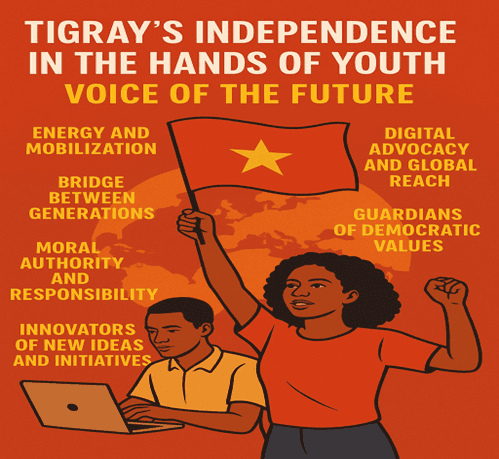
Tigray’s Independence in the Hands of Youth
September 3, 2025