
Consensus as an Enhancement Strategy, Not a Precondition to Voicing for Independent Tigray: Debating the View of ‘Consensus First’ vs. ‘Independence Can’t Wait’
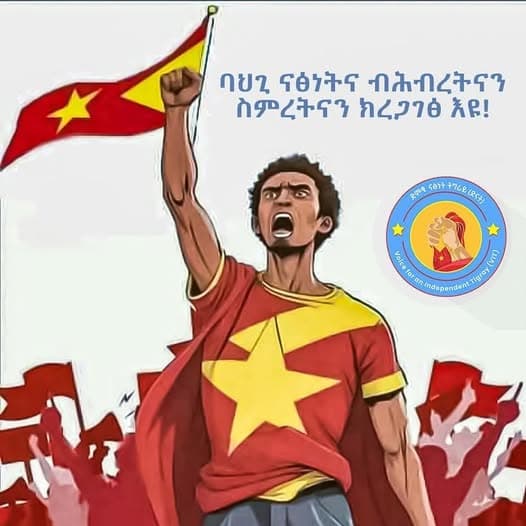
Consensus as an Enhancement Strategy, not a Precondition to Voicing for Independent Tigray.
Introduction
On May 31, 2025, the Voice for an Independent Tigray (VIT) officially launched its mission, vision, and foundational cause: to advance the case for Tigray’s independence through principled advocacy, historical reckoning, and democratic mobilization. Since its formation, VIT has ignited passionate and sometimes polarized debate across Tigray’s political spectrum.
Among the most vocal critics are those who seek the complete decimation of the Tigray People’s Liberation Front (TPLF) and its removal from Tigray’s political future. They argue that the push for independence is ill-timed and tactically designed to rehabilitate or preserve the TPLF’s waning influence. Some even allege that TPLF is either behind the movement or poised to hijack it for its own survival. These critics frame the independence agenda as a strategic distraction- a political maneuver aimed at shielding TPLF.
VIT firmly rejects this narrative. It made its position clear. The movement is non-partisan, independent, and committed solely to the cause of Tigray’s self-determination. Its objective is neither to save one political party nor decimate another. Rather, its central mission is to educate, advocate, and build broad-based awareness around the right of the people of Tigray to chart their own sovereign future. To that end, VIT calls on all political organizations, including the TPLF, to adopt and champion the cause of independence. VIT views any party’s decision to embrace its mission not as a threat or an act of 'hijacking' but as a valuable contribution to a just and unified struggle.
Such alignment is seen as a plus to VIT’s success but not as an act of takeover or manipulation.
VIT maintains that the question of whether any political party survives or fades away is not for it to decide. Such power resides in the sovereign right of the people. Democratically speaking, the fate of the TPLF or any political organization must be determined through transparent democratic processes and the sovereign will of the people, not through suspicion, vilification, or scapegoating. When a political force seeks to rise not on the strength of its vision or policies, but on the decimation of its rival, it is not practicing democracy. It is embracing anarchy. True democracy is built on ideas, not vendettas.
The notion that one supports Voice for an Independent Tigray (VIT) "but only if TPLF is not involved" undermines the very essence of VIT’s cause. If one truly believes in Tigray's right to independence, that belief should not be conditional. The legitimacy of the movement does not rest on who started it or who supports it—it rests on the justness of the cause itself. Putting a precondition is to conflate personal or partisan grievances with a national aspiration. This weakens the broader struggle. The focus should remain on the end goal: Tigray's right to self-determination and sovereign statehood.
It is well-known that the TPLF has historically opposed independence. However, if it now supports the cause, this shift should not be dismissed as an act of hijacking. On the contrary, it should be viewed as a positive political development, a sign that the cause is gaining traction across the political spectrum. The more actors that align themselves with the goal of independence, the stronger and more legitimate the movement becomes. Treating TPLF’s participation as a threat rather than an opportunity risks creating unnecessary divisions among people who already face existential threats. Independence movements succeed not by enforcing ideological purity tests, but by building broad coalitions committed to a common vision. That vision must transcend individual parties and personalities. In short, true commitment to Tigray's independence means prioritizing the cause over political rivalry. The measure of one's support should not be who is involved, but what is being fought for.
Despite efforts to delegitimize its platform, VIT continues to press forward, grounded in the conviction that the pursuit of independence must not be held hostage by internal rivalries or the fear of political association. Its commitment is clear: to build a movement driven by the people, rooted in truth, and unwavering in its vision for a free and dignified Tigray.
Debating the View of 'Consensus First' vs. 'Independence Can't Wait'
The pursuit of national independence is rarely linear. For Tigrayans, a people ravaged by war, subjected to genocide, and betrayed by political leadership, the path is particularly perilous. Emerging from the wreckage of collective trauma and institutional collapse, a renewed call for self-determination has gained momentum. Yet, despite its emotional and moral urgency, the movement faces internal challenges. Critics turn their gaze inward, toward a deeply fragmented political landscape, rife with unanswered questions and competing visions for Tigray’s future. Their main concern centers on this view: A national consensus must precede any push for independence. In their view, in the absence of political consensus and inclusive engagement, the independence movement remains far from viable because political fragmentation and deep mistrust are eroding Tigray’s unity.
This critique warrants serious and deliberate engagement. Not as a defeatist stance but as a legitimate challenge that demands clarification, strategic response, and principled resolution. Addressing it requires a balanced examination of both the strengths and limitations of the argument, while critically assessing what independence truly offers in practical terms: cultural preservation, social cohesion, economic opportunity, and genuine political self-determination. And at its heart, the debate should raise deeper questions: What does true liberation mean for a people who have endured the unimaginable? And how do they imagine a sovereign future while rebuilding from the ruins of war and betrayal? These are not abstract questions. They are existential questions that demand honest dialogue, not driven by myopic or self-serving interests, but grounded in a people-centered, forward-looking vision, and the courage to rise above fear in pursuit of a shared purpose.
The Opponents View
One of the most pressing concerns raised by critics of Tigray’s push for independence is the profound fragmentation of political vision and internal cohesion among its people. While there is broad consensus on the need for justice, security, and self-determination in the wake of war and genocide, there is far less agreement on the institutional structure and ideological foundation of a future Tigrayan state. This lack of clarity is further compounded by a growing mix of instances of political defamation, arrogance, opportunism, and factional power competition. Rather than uniting around a shared national agenda, some political actors appear more focused on scoring points to advance their political dominance, even at the expense of collective priorities. The perception that one political group seeks to thrive over the decimation of another not only breeds mistrust but also undermines the credibility and moral authority of a broader societal responsibility.
Moreover, opinions on Tigray’s future diverge sharply. Some advocate for the status quo of the pre-2020, a federal arrangement within an Ethiopian polity, to continue. Others call for a fully independent republic that envisions a political order anchored in Tigray’s historical and sociocultural values. Economic visions are similarly varied, ranging from social democracy, the revolutionary developmental state model, to free-market neoliberalism.
Opponents of independent Tigray or those who argue that the question of independence is untimely further argue that these ideological and strategic diversities, though a natural feature of any pluralistic society, are structural weaknesses and obstacles in the absence of inclusive political dialogue, collective consensus and a shared national framework.
According to this critique, the lack of a unifying political ideology or collective strategic vision undermines the movement’s ability to articulate a coherent agenda, mobilize inclusive support, and engage credibly with domestic constituencies and international stakeholders.
Without foundational agreement on governance, economic priorities, and the rule of law, the independence movement risks internal fragmentation and elite power struggles. The critics further argue that the current fragmentation is not merely about differing policy views. It reflects a deeper crisis of political culture, one where the struggle for liberation risks being co-opted by internal rivalries, personal ambition, and a zero-sum mentality. They further argue that without a process to contain and mediate these divisions through principled dialogue, power-sharing mechanisms, and an inclusive national vision, VIT’s movement risks splintering. In their view, independence pursued under such conditions could replicate the very dynamics of exclusion, instability, and authoritarianism that Tigrayans seek to escape.
However, this critique, while valid in its caution, rests on a presumption that overstates the necessity and feasibility of complete ideological consensus before independence. To begin with, consensus in pluralistic societies is rarely total. Diversity of political vision is not a liability in itself, but a sign of democratic maturity and intellectual vitality. The mere existence of divergent views-whether on governance structure, political ideology, and economic policy-should not be interpreted as a structural weakness, but as the raw material from which post-independence dialogue, negotiation, and institutional design can emerge.
Moreover, the demand for a fully articulated and unified consensus before independence risks setting an impossible standard: one that no liberation movement in history has fully met. As seen in past struggles for sovereignty across Asia, Africa, Europe, and the Americas, liberation has often preceded constitutional clarity. Tigray’s case is no exception: the trauma of genocide, war, and political betrayal has fundamentally eroded trust in the Ethiopian state, and continuing to delay self-determination in pursuit of perfect agreement risks paralyzing momentum, demobilizing support, and deepening public disillusionment.
In addition, the expectation that all foundational principles, such as governance structures and political resentments, must be resolved before asserting sovereignty reflects a top-down, technocratic view of state formation. In reality, these principles evolve through political participation, civic engagement, and institutional development. Delaying independence until such matters are settled assumes that the people of Tigray cannot govern difference democratically or negotiate conflict constructively. This is a problematic and ultimately disempowering premise.
Proponents View
The proponents of VIT assume political consensus as a broad agreement among political actors on key issues or the direction of a nation. Their view is not about total unanimity but about building shared understanding through dialogue, compromise, and mutual respect; and true consensus is people-centered and forward-looking, aimed at fostering stability, legitimacy, and collective ownership of political outcomes. However, they argue, political consensus should never be misused as a delaying tactic or imposed as a precondition for voicing the right to independence.
The pursuit of self-determination is a fundamental and inalienable right that can and must be articulated even as consensus continues to evolve. Waiting for perfect consensus before taking a stand on existential issues is not a sign of democratic maturity but a path to paralysis.
Furthermore, using the absence of consensus as a justification to delay voicing the demand for an independent Tigray unfairly places the burden of perfection on the oppressed, rather than on the systems and actors responsible for their suffering. It diverts attention from the genocidal war and humanitarian crisis inflicted by the Ethiopian state and instead portrays the natural political dynamics within a traumatized yet resilient people as a problem or dysfunction.
This framing not only distorts reality but risks silencing a just struggle under the guise of procedural caution. Yes, internal dialogue and coordination are essential, but they must not be weaponized as excuses to indefinitely postpone the right to self-determination. Independence is not the conclusion of democratic development; it is the foundation upon which genuine democracy can finally be built, free from external domination and existential threat.
Historical Experiences
Throughout history, successful liberation movements-from Algeria to South Sudan, from India to Vietnam, and Kosovo-have navigated deep internal ideological, ethnic, and political divisions without waiting for perfect alignment before asserting their sovereignty.
The anti-colonial movement in India overcame stark contrasts between secularists and religious nationalists.
Vietnam’s struggle for independence united competing communist and nationalist factions.
South Sudan gained independence despite serious ethnic divisions and political fragmentation, albeit with post-independence challenges.
Eritrea’s experience demonstrates that national liberation is not dependent on perfect internal agreement. Eritrea fought for its freedom for three decades against authoritarian rule, entirely without political consensus, and achieved independence through a bloody war. Yet some mistakenly cite Eritrea’s lack of democracy as if independence itself were the cause of democratic failure, an illogical and misleading argument.
First, independence does not guarantee democracy. It merely creates the sovereign space within which democratic institutions can be built, if chosen. The failure to democratize is not a failure of independence. It is a failure of leadership and political will.
Second, the presence of consensus and democracy today does not ensure their permanence tomorrow. These are not static conditions. They are fragile, subject to reversal at any time. Ethiopia is a clear example. Beginning in 1991 and up to 2018, there was genuine hope for a democratic opening in Ethiopia, built on a broad consensus among its Nations and Nationalities that ethnic federalism could serve as a framework for peace, justice, and equality. This arrangement was seen not as a threat to unity but as a means to acknowledge diversity and prevent domination. However, in a remarkably short time, that consensus was shattered. Democratic norms rapidly deteriorated, authoritarianism resurfaced, and today, Ethiopia finds itself on the verge of disintegration. These realities underscore a fundamental point: using the absence of consensus or the fear of undemocratic outcomes as a reason to delay or suppress calls for independence is deeply flawed. It is not consensus that enables liberation, but liberation that allows the conditions under which genuine consensus and democratic governance can be pursued. The choice between democracy and tyranny ultimately rests with the people and their political forces, not in preconditions but in post-independence commitment and action.
Across Asia, countries like Indonesia and Bangladesh emerged from violent struggles marked by deep political fractures. Indonesia faced divisions between Islamic, nationalist, and communist factions, yet declared independence from Dutch colonial rule in 1945. Bangladesh won independence from Pakistan in 1971, despite internal conflict over the balance between secular and religious identity.
In Europe, nations such as Ireland and the post-Yugoslav states (e.g., Slovenia, Croatia, Bosnia and Herzegovina) achieved independence in the face of deep sectarian and ethnic divisions. Kosovo, in particular, declared independence in 2008 without a unified vision among its internal political actors, and continues to negotiate the contours of its governance structure.
In Africa, Zimbabwe (formerly Rhodesia) and Namibia gained independence after years of armed struggle and political division among liberation movements, which were at least managed through transitional arrangements after sovereignty was achieved.
Even in North America, the United States’ own path to independence was marked by intense ideological disagreement among colonies—between federalists and anti-federalists, slaveholding and free states, urban commercial interests and rural agrarian communities. Yet, independence was asserted before these divisions were resolved, and the nation’s constitutional framework emerged only afterward, through vigorous debate and compromise.
In all these cases, national liberation preceded comprehensive internal consensus, which was pursued imperfectly but necessarily through post-independence institution-building and negotiation. For advocates of Tigrayan independence, these examples underscore the view that sovereignty is not the end of political fragmentation, but the beginning of the legitimate process for resolving it.
Therefore, to conflate the struggle for self-determination with the absence of democratic outcomes is to misread history and obscure the true cause of democratic failure. Ultimately, it is up to the people and their political forces to choose their path—toward democracy or tyranny. Using the lack of consensus or clearly defined political arrangements as a precondition for voicing the demand for independence is both unnecessary and counterproductive.
Liberation comes first; democracy must be built through struggle, choice, and responsible leadership thereafter.
Consensus is not a precondition for liberation, but a process to be built through and after independence. Waiting for a complete ideological or institutional consensus in a society emerging from war, genocide, and state collapse is both unrealistic and strategically paralyzing.
In summary
Tigray’s current fragmentation of vision should not be used as a justification for delay, but rather as a challenge to be addressed after independence is secured. Postponing the independence process in pursuit of perfect consensus risks demobilizing the movement, demoralizing the people, and emboldening hostile actors. Political unity is not a prerequisite for liberation—it is often the result of the difficult but necessary work of nation-building. Constitutions, institutions, and mechanisms for power-sharing, cultural inclusion, and economic justice can—and must—be developed in a post-independence context. Independence is not the final destination; it is the precondition for meaningful democratic self-determination.
While the lack of consensus is real, it is not fatal. In fact, the very act of securing independence—if done with vision and integrity—can help create the conditions for genuine consensus by giving the people of Tigray the sovereign space to debate, decide, and shape their own future.
Under Ethiopian rule, the people of Tigray have endured not just marginalization but annihilation. No system of governance within Ethiopia has ever guaranteed the protection of Tigrayan identity, life, or liberty. When a people are governed as a despised minority, their voices are drowned out in every national decision—security, education, language, infrastructure, and justice. Independence changes this dynamic.
It allows the people of Tigray to govern themselves—not just symbolically, but substantively. This shift transforms the relationship between the individual and the state: rights become enforceable, dignity becomes protected, and governance becomes responsive rather than extractive. People begin to matter—not as demographic footnotes, but as citizens.
An independent Tigray means the preservation and promotion of Tigrinya and other local languages. It means that indigenous history, literature, and customs are no longer ignored or erased.
Instead, they are taught, celebrated, and used as sources of pride and resilience. In contrast, the Ethiopian state has historically undermined Tigrayan culture through discriminatory education policies, media censorship, and systematic marginalization in national discourse. Independence reclaims not just land, but memory, language, and identity.
No successful liberation movement has ever begun with complete consensus about what would follow. The American revolutionaries did not agree on the U.S. Constitution when they declared independence. South Africans could not fully envision what post-apartheid governance would look like while still under white rule. Eritreans debated fiercely among themselves even as they fought for their freedom. Consensus is not born under occupation—it is born in the crucible of self-rule.
What unites a people in their struggle for independence is not identical political beliefs, but a shared commitment to self-determination. It is precisely through having our own government, institutions, and media that we can finally engage in the debates we’ve long been denied—and build consensus through democratic processes.
In conclusion, the movement for independence does not require perfect unity. What Tigray needs is purposeful agency. To demand national consensus before independence is to put the cart before the horse. It is like asking a captive people to design their dream house while their village is burning. The truth is, consensus is easier to build once we are free to speak, debate, vote, and choose—without fear of repression. Under Ethiopian domination, genuine consensus is impossible because there is no space for honest dialogue when people are treated as second-class citizens. Independence is not the end of debate—it is the beginning of real democracy. It is not a reward for unity; it is the foundation upon which unity can be forged.
So let us not be paralyzed by our diversity of opinion. Let us embrace it—and build a sovereign state where all voices can be heard. Because the alternative is clear: silence, subjugation, and erasure under a regime that sees the very existence of the people of Tigray as a problem. The struggle for independence is not about perfection. It is about survival, dignity, and self-governance. And it must continue—with clarity, with courage, and with the understanding that consensus is not a precondition for liberation—it is the fruit of it.
Recent News
ኢትዮጵያ ትግራይን እየገፋች ነው፦ ከታሪክና ትውስታ የመፋቅ ዓላማ ይዞ የመጣው ጦርነት፣ የተፈፀሙት አረመንያዊ ወንጀሎች እና ተዛማጅ ክህደቶ ያነጠፉት አስገዳጅ ፍቺ
January 28, 2026
Independence is the Soil, Democracy the Seed
September 14, 2025
A New Year’s Wish and Call to Unity from the Voice for an Independent Tigray
September 9, 2025
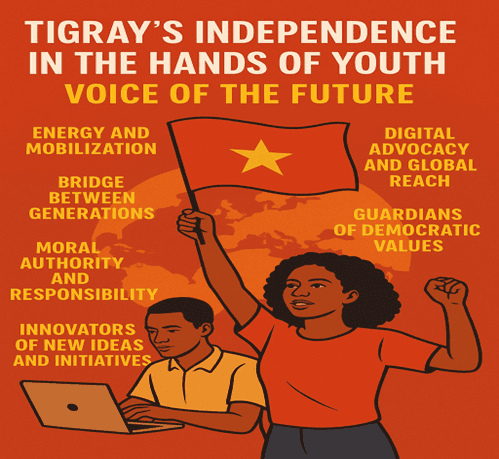
Tigray’s Independence in the Hands of Youth
September 3, 2025